View from the Trestle Table
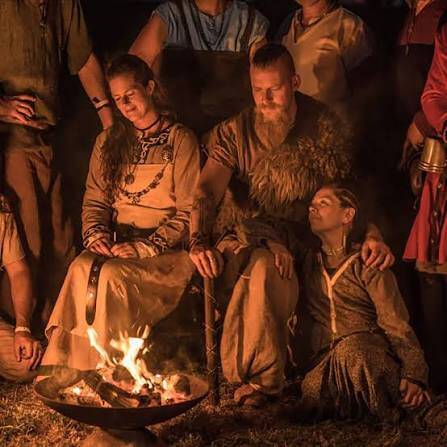
The View From Behind the Trestle Table
Welcome to Dark Age Traders — and to the side of the re-enactment field that visitors rarely see. ----- If you’ve ever wandered through a Viking market on a Saturday afternoon — woodsmoke in the air, a smith hammering somewhere off to your left, a man in a woollen tunic explaining to a child exactly how a seax differs from a sword — then you’ve seen our world from the front. Our Website is about the other side. The view from behind the trestle table. Because every horn cup, every hand-stitched pouch, every bolt of madder-dyed wool laid out on those stalls got there somehow. Someone sourced it, vetted it for the period, hauled it across the country in a van at five in the morning, and set it up in the rain before the public arrived. That journey — the events, the suppliers, the people, and the small daily absurdities of living history as a working life — is what we want to write about here.
What this site is for Dark Age Traders is part journal, part noticeboard, part community. We’re building it around four things:
The Event Calendar. - Which shows are worth the diesel? Which fields flood? Which organisers run a tight, well-attended event and which leave you parked behind a hedge with three visitors and a tombola? We’ll keep an honest, working calendar of Medieval and Viking events across the UK, written from the perspective of people who actually trade and camp at them.
Stock & Suppliers. - The unglamorous, genuinely useful stuff: where good materials come from, what “period-accurate” actually means once you scratch the surface, and how to tell a properly made piece from something that photographs well and falls apart in a season. We’ll be candid about provenance, because the re-enactment world runs on trust.
Re-enactment Life. - The texture of it. Kit that works versus kit that looks the part. The weather. The camaraderie around a fire after the public has gone home. The quiet skill in a craft that took someone fifteen years to learn and ninety seconds to demonstrate to a passer-by.
Trader Spotlight. - The makers and merchants themselves. Many of the best are not businesses in any tidy sense — they’re a person, a workshop, a body of knowledge, and a stubborn refusal to cut corners. Those people deserve more than a stall sign.
A word about authenticity The re-enactment community argues endlessly about authenticity, and it should. It’s the thing that separates living history from fancy dress. But authenticity isn’t a finish line you cross — it’s a direction you keep walking in. The archaeology is incomplete. The textiles rot. Reasonable people disagree about whether a given dye, weave, or construction technique is defensible for a given time and place. What matters is that the questions are asked honestly, that claims are backed by something, and that nobody pretends a guess is a certainty. That’s the standard we’ll hold ourselves to here, including when we get something wrong — which, over enough posts, we will. If you spot it, tell us. The best corrections we’ve ever received came from someone leaning over a stall with a strong opinion and a good source.
Why now - The UK living-history scene is, by most measures, in good health. Events are well attended, the craft skills are being passed on, and a new generation is discovering that history is far more interesting when you can hold it, wear it, and cook over it. But the knowledge that holds it all together — who makes what, which suppliers are sound, what’s worth your money and your weekend — still mostly travels by word of mouth across muddy fields. This site is an attempt to write some of that down.
Come and find us - For now the calendar is filling up, the supplier pages are taking shape, and the first proper Trader Spotlight is in the works. If you trade, make, organise, or simply turn up in wool every weekend from April to September, we’d like to hear from you.
Pull up a stool. The fire’s lit, the kettle — anachronistically — is on, and there’s a great deal to talk about.